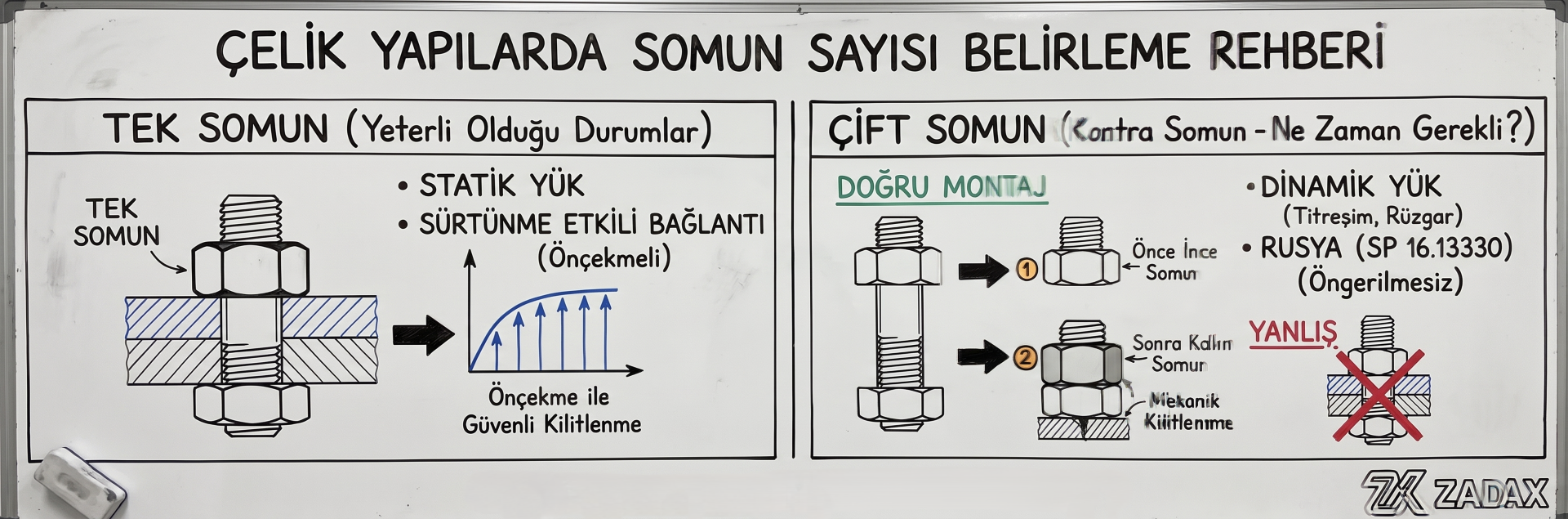
Bolted connections are one of the most critical safety elements in the design and erection of steel structures. Questions frequently encountered on job sites or during the design phase—such as "Should we use a single nut or double nuts here?" or "Which standard dictates what?"—directly determine the lifespan of the structure under seismic, wind, and dynamic vibration loads.
So, what do Turkish, European, American, and Russian steel structure codes say about nut usage? How do you select the appropriate nut configuration for bearing-type and slip-critical connections? Let us examine these technical details through core engineering principles.
The classic method used to prevent bolts from loosening under dynamic loads, machine vibrations, or thermal fluctuations is the double nut (jam nut) application. However, for this system to function properly, it relies heavily on the correct installation sequence and torque ratios.
The Most Common Field Mistake!
On many job sites, you will see the thin nut (jam nut) installed on top of (outside) the thick nut. This is fundamentally wrong and fails to prevent loosening!
According to mechanical principles, the correct installation sequence is as follows:
When executed this way, the upper thick nut relieves the axial load from the lower thin nut. The bolt threads tighten by bearing against the top flank of the thin nut and the bottom flank of the thick nut. Because the thread clearance (backlash) is completely eliminated, relative movement becomes impossible, achieving a true locking action (jamming). Junker vibration tests consistently prove that this proper assembly—thin nut underneath—provides superior resistance against self-loosening.
Important Note: When applying high torque to stainless steel or alloy bolts, suitable assembly pastes or anti-seize lubricants must be used to prevent thread galling (cold welding).
In Türkiye, steel structure design is governed by the Regulations on Design, Calculation, and Construction Principles of Steel Structures (ÇYTHYDE). While this specification references American AISC 360 for design calculations, it refers to European Norms (EN) for fabrication and material specifications.
Under TS EN 1090-2, connections are divided into preloaded and non-preloaded types. In preloaded systems, bolts are brought to a high axial tensile force ($F_{p,C} = 0.7 f_{ub} A_s$) via controlled tightening. Because this high clamping force naturally locks the threads, TS EN 1090-2 projects do not require an additional jam nut or locking device for preloaded connections.
| System Type | Standard No. | Tightening Condition | Anti-Loosening Measure | Nut Quantity |
|---|---|---|---|---|
| SB (Non-preloaded) | EN 15048 | Snug-tight | Double nut or lock washer if dynamic load exists | Single (Static) / Double (Dynamic) |
| HR (High Strength) | EN 14399-3 | Preloaded | Friction lock via high preloading force | Single Nut |
| HV (High Strength) | EN 14399-4 | Preloaded | Friction lock via high preloading force | Single Nut |
| HRC (Twist-off) | EN 14399-10 | Preloaded | Controlled tip shearing via calibrated torque | Single Nut |
In HV (German) systems, thinner nuts are preferred so that the bolt shank fails in tension before thread stripping occurs. In contrast, HR (French) systems utilize thicker nuts and longer thread lengths to enhance ductility.
Russian standards feature the most stringent anti-loosening rules in the international arena. Pursuant to SP 16.13330 (the structural steel code of the Russian Federation):
Additionally, Russian norms mandate the minimum nut strength classes based on the bolt grade and loading condition:
| Bolt Grade | Min. Nut Grade (Shear & Tension) | Min. Nut Grade (Shear Only) |
|---|---|---|
| 5.6 | Class 5 | Class 4 |
| 8.8 | Class 8 | Class 5 |
| 10.9 | Class 10 | Class 8 |
| 12.9 | Class 12 | Class 10 |
According to the American Institute of Steel Construction (AISC 360) and RCSC specifications, using a single nut with a standard washer is standard practice for building structures. However, double nuts are required in moment connections under seismic loads, bridges, and highway sign support anchor systems (under AASHTO specifications).
In American AASHTO standards, specific turn-of-the-nut tolerances are defined for ASTM F1554 anchor rods used in double-nut moment connections. These rotation values represent the additional turn required after reaching the snug-tight condition:
The core engineering criterion determining the number of nuts in a bolted connection is the manner in which external loads are transferred through the joint.
In this connection type, load is transferred by the connected plates bearing against the bolt shank and subjecting the bolt to shear. Bolts are generally left in a snug-tight condition.
Loads are transferred through the high frictional force developed between the contact surfaces (faying surfaces) as a result of fully torque-tightening high-strength bolts.
The bolt grade (strength class) directly affects the locking capability of the assembly:
Disclaimer: This document is provided for general informational purposes only. For any structural connection design and nut detailing on your specific project, always seek formal review and approval from a licensed Structural/Civil Engineer.
1. Avrupa ve Türk Standartları (EN / TS EN)
TS EN 1090-2 & TS EN 14399 Kalite Planı ve Öngerilmeli Cıvata Kılavuzu - Link: https://yuksekihtisasuniversitesi.edu.tr/Uploads/duyurular_view/a98dbd893c992331c80561be9dee4bfe.pdf
Berenbak, J. (2012). "Reliability preload methods EN 1090-2" - Bolt Council Raporu - Link: https://www.boltcouncil.org/files/236_voorspanbouten_rapport.pdf
BS EN 1090-2:2008 Çelik Yapı İmalat ve Uygulama Standardı - Link: https://www.scribd.com/document/963788040/Attachment-1-BS-EN1090-2-2008
EN 1090-2 Standardında Geçen Bağlantı Elemanları Portalı - Link: https://www.en1090-2.org/en-1090-bilgiler/76-en-10902-standardinda-adi-gecen-baglanti-elemanlari-ile-ilgili-standartlar
VIPA SpA - Çelik Yapı Cıvataları (EN 14399, EN 15048, EN 1090-2) Teknik Rehberi - Link: https://www.vipaspa.it/en/structural-bolts-en-14399-en-15048-en-1090-2/
DergiPark - TS EN 1090-2 ve ÇYTHYDE Kalite Kontrol İlişkisi Araştırması - Link: https://dergipark.org.tr/tr/download/article-file/2009940
T.C. Çevre, Şehircilik ve İklim Değişikliği Bakanlığı - Çelik Yapıların Tasarım, Hesap ve Yapım Esasları Yönetmeliği Uygulama Kılavuzu - Link: https://www.scribd.com/document/729379397/Celik-Yapilar-Yonetmeligi-Uygulama-Klavuzu-Csb
Türk Yapısal Çelik Derneği (TUCSA) - Çelik Yapılar Yönetmeliği Ek Kılavuzu - Link: https://www.tucsa.org/images/yayinlar/ucretsiz_yayinlar/celik_yapilar_yonetmeligi_7-5-22822-Ek.pdf
İMO İstanbul - Çelik Yapılar Tasarım Yönetmeliği Seminer Notları (Sezai Güvensoy) - Link: https://imoistanbul.org/imoarsiv/seminer-notlari-ekim-2016/sezai-guvensoy/seminer-notlari.pdf
Çelik Yapıların Tasarım, Hesap ve Yapım Esasları Yönetmeliği (ÇYTHYDE) Resmi Gazete Metni - Link: https://www.tolay.com.tr/files/2024/01/turkish-steel-design-code-.pdf
2. Amerikan Standartları (AISC / RCSC / AASHTO)
RCSC (Research Council on Structural Connections) - Specification for Structural Joints Using High-Strength Bolts - Link: https://www.aisc.org/aisc/publications/current-standards/rcsc-standard/
Portland Bolt - Turn of the Nut Method (Somun Döndürme Yöntemi) ve Ankraj Uygulamaları - Link: https://www.portlandbolt.com/technical/faqs/turn-nut-method/
BMA Engineering - Yapısal Cıvatalama Tasarım ve Uygulama Notları (AISC/RCSC) - Link: https://www.nrc.gov/docs/ml1214/ml12146a143.pdf
University of Memphis - CIVL 3131 Çelik Yapı Bağlantıları Ders Notları (Yüksek Mukavemetli Cıvatalar) - Link: http://www.ce.memphis.edu/3131/notes/pdfs/Chapter_7.5-6_connections.pdf
Al-Mustansiriya University - Çelik Yapılarda Esnek ve Rijit Bağlantı Tipleri Notları (AISC) - Link: https://www.uomustansiriyah.edu.iq/media/lectures/5/5_2019_03_06!04_25_04_PM.pdf
Industrial Monitor Direct - Önçekmesiz (Snug-Tight) ve Önçekmeli (Preloaded) Birleşim Farkları - Link: https://industrialmonitordirect.com/blogs/knowledgebase/structural-bolt-torque-non-preloaded-vs-preloaded-connections
Grokipedia - Sürtünme Etkili (Slip-Critical) Birleşim Tasarımı ve Yüzey Sınıfları - Link: https://grokipedia.com/page/Slip-critical_joint
Haydon Bolts - Çelik Bağlantı Tipleri (Snug-Tightened, Pretensioned, Slip-Critical) - Link: https://haydonbolts.com/products/joint-types/
3. Rusya Standartları (SP / SNiP / GOST)
SP 16.13330.2017 "Стальные конструкции" (Rusya Çelik Yapılar Resmi Standart Dokümanı) - Link: https://vrn.legionural.ru/upload/documents/%D0%A1%D0%9F%2016.13330.2017%20%D0%B8%D0%B7%D0%BC1.pdf
SP 16.13330.2017 Değişiklik No:3 (Temel Ankraj Bulonları ve Malzeme Güncellemesi) - Link: https://nav.tn.ru/cloud/iblock/33d/33dbefaca95908f1bf9248481cdd98b7/SP-16.13330.2017-Izmenenie--3_.pdf
Meganorm - SP 16.13330.2017 Resmi Standart Portalı - Link: https://meganorm.ru/mega_doc/norm_update_29032025/pravila/0/sp_16_13330_2017_svod_pravil_stalnye_konstruktsii.html
Meganorm - СНиП II-23-81 (SP 16.13330) Arşiv Doküman Sayfası* - Link: https://meganorm.ru/Data2/1/4293745/4293745484.htm
Garant.ru - SP 16.13330 Standardına Göre Sismik Alanlarda Gevşeme Emniyeti - Link: https://www.garant.ru/products/ipo/prime/doc/70198900/
OSTEC - Kablo Kanalı Sistemleri ve SP 16.13330 Uyarınca Cıvata Sabitleme Kuralları - Link: https://ostec.ru/upload/iblock/1b8/aa2w4mb6v8k8zs18fmuvwjan1q87asop/Instruktsiya_KNS_2025.pdf
ETP Metal-IT - Modüler Çelik Yapılar Teknik Şartnamesi ve SP 16 Standartları - Link: https://etp.metal-it.ru/files/get/3XgS7KtJpAi6nQiiCvCRKMRvNZb8y8MbV7uJtK9HcwcyFDNvbjynVPbik8swT64saK/%D0%A2%D0%B5%D1%85%D0%BD%D0%B8%D1%87%D0%B5%D1%81%D0%BA%D0%BE%D0%B5%20%D0%B7%D0%B0%D0%B4%D0%B0%D0%BD%D0%B8%D0%B5.pdf
CCCP3D Forum - Rus Yapı Mühendisliği Forumu SP 16 Kontra Somun (Контргайка) Normları - Link: https://cccp3d.ru/topic/140113-%D0%BC%D0%BE%D0%BC%D0%B5%D0%BD%D1%82-%D0%B7%D0%B0%D1%82%D1%8F%D0%B6%D0%BA%D0%B8-%D0%BA%D0%BE%D0%BD%D1%82%D1%80%D0%B3%D0%B0%D0%B5%D0%BA/
ZMK.ru - SP 16.13330.2017 Madde 13 ve 14 Çerçevesinde Çelik Montaj Detayları - Link: https://www.zmk.ru/wp-content/uploads/2022/11/417-08.21-%D0%90%D0%A11-%D0%B8%D0%B7%D0%BC.123.pdf
4. Gevşeme Mekanizmaları, Çift Somun Teorisi ve Kilitleme Teknolojileri
Bill Eccles (Bolt Science) - "The Use of Two Nuts to Prevent Self-Loosening" (Junker Titreşim Analizi) - Link: https://www.boltscience.com/pages/twonuts.htm
Matrix Engineering - İnce Somun (Jam Nut) Sıkma Sırası ve Mekanik Kilitlenme Teorisi - Link: https://www.matrixengrg.com/the-use-of-two-nuts-to-prevent-self-loosening-intro/
AYA Fasteners - Çift Somun Sisteminde Dişlerin Birbirine Sıkışması (Jammed Threads) İlkesi - Link: https://www.ayafasteners.com/news/the-use-of-two-nuts-to-prevent-self-loosening-63844149.html
Industrial Monitor Direct - Ağır Altıgen Somunlar (ASTM A563/A194) ve Çift Somun Tasarımı - Link: https://industrialmonitordirect.com/blogs/knowledgebase/double-nut-anchor-bolt-substitution-requirements
Nord-Lock Group - Çelik Yapı Pulları ve Junker Testine Göre Önçekme Kayıplarının Engellenmesi - Link: https://www.nord-lock.com/tr-tr/nord-lock/by-industry/steel-construction/